'/%3e%3c/svg%3e)
'/%3e%3c/svg%3e)

Why you're losing with options (I've lost money so you don't have to).
The 5 critical mistakes in entry, trade lifecycle and exit that are ruining your options strategies, no matter how well thought out your investment case is.

Today's article comes from real experience and frustration. Like many other intermediate options traders, I reached a familiar crossroads: I was skilled enough to construct options strategies, yet unaware of how entry, trade management, and exit decisions quietly shaped the slow burn (or sometimes rapid decline) that was happening before my eyes.
If you're in the same situation, there are two paths ahead. One leads to repeated underperformance and frustration (been there, done that). The other is far more optimistic, leading you through this article and addressing some of the most common weaknesses in options trading like:
- Why you probably shouldn't buy "cheap" options
- Stop overpaying for optionality
- The costly killers post-entry (IV and theta)
- Finding the inner strength to exit a position
- Removing emotion with structured limit orders
Entry
Cheap options are cheap for a reason
Many options traders with smaller accounts fall into the same trap over and over again. Cheap options look irresistible. Low upfront cost, massive upside; surely that's the fastest way to grow an account?
The problem is probability. The likelihood of those options paying off is so low that, over time, you're unlikely to see consistent returns. But you might think, "I can't afford more expensive options that offer steadier results". That's certainly a common misconception, and we break down exactly which option strategies disprove such a statement in this article.
Overpaying for optionality
If you're wondering what optionality is, or how you might be overpaying for it, you should definitely keep reading, because this is a classic pitfall for many intermediate options traders.
Optionality is simply the value of having choice. When you buy options, you're paying for that flexibility, and often paying a lot for it.
The catch is that optionality is frequently mispriced by the market. That mispricing largely comes down to Implied Volatility (IV). IV is the market's embedded expectation of how much an asset's price might move. Higher IV means traders are willing to pay more for optionality; lower IV means less. I've written another piece on IV that covers the concept in more detail.
So how do you know if you're overpaying? If you're buying options when IV is high relative to its historical levels or to realized volatility, you're paying a heightened premium. The key question to ask yourself is whether that premium is justified by actual market conditions. If it isn't, you're likely overpaying for optionality.
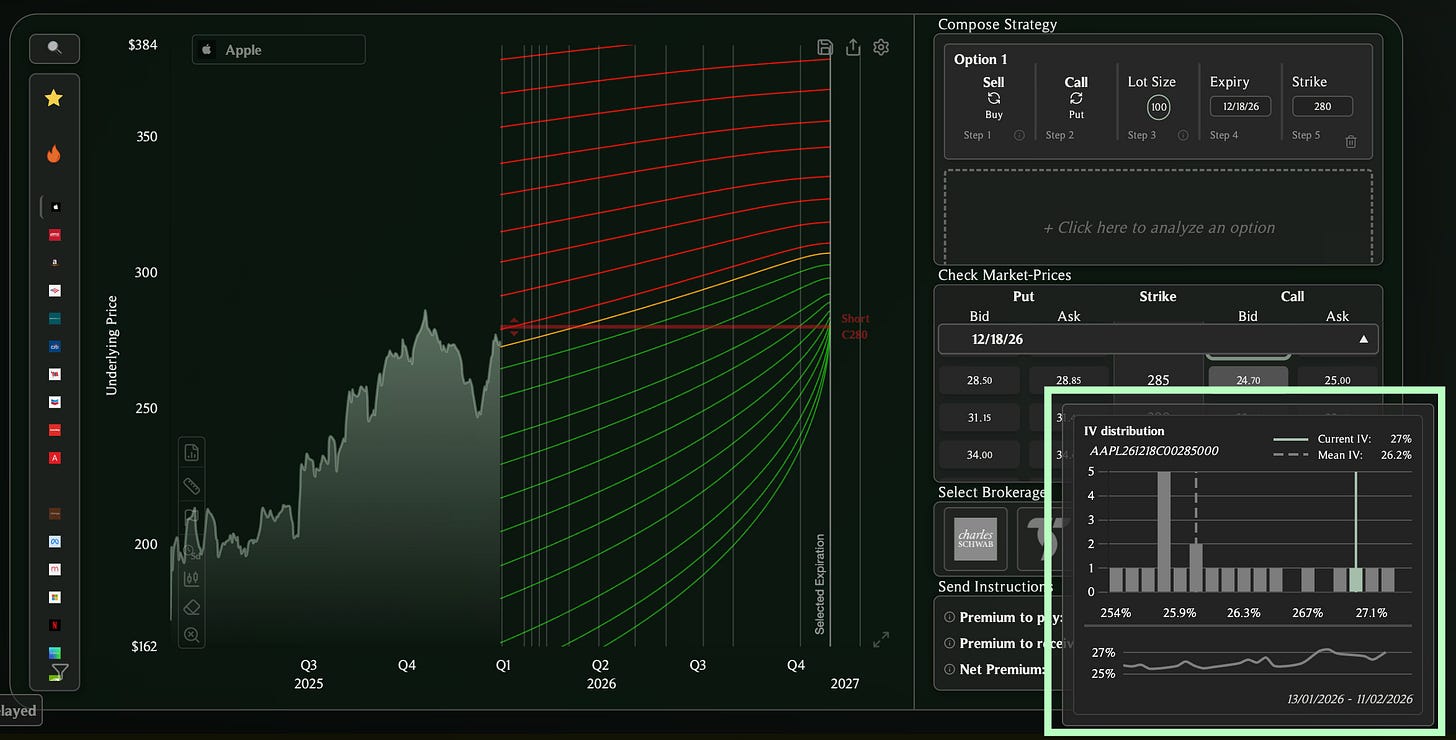
Lifecycle
The silent killers; IV and theta
So what should you be watching next after entering the trade? Two forces matter above all else: time decay (theta) and implied volatility (IV).
If you're reading this, you likely understand what theta is. What's often less clear is when it starts to hurt. Option value doesn't decay at a constant rate, there's a point in the lifecycle where decay accelerates rapidly. From an exit perspective, this is critical. There's no point in flogging a dead horse. In OptiView, you can clearly see where in the timeline this occurs.
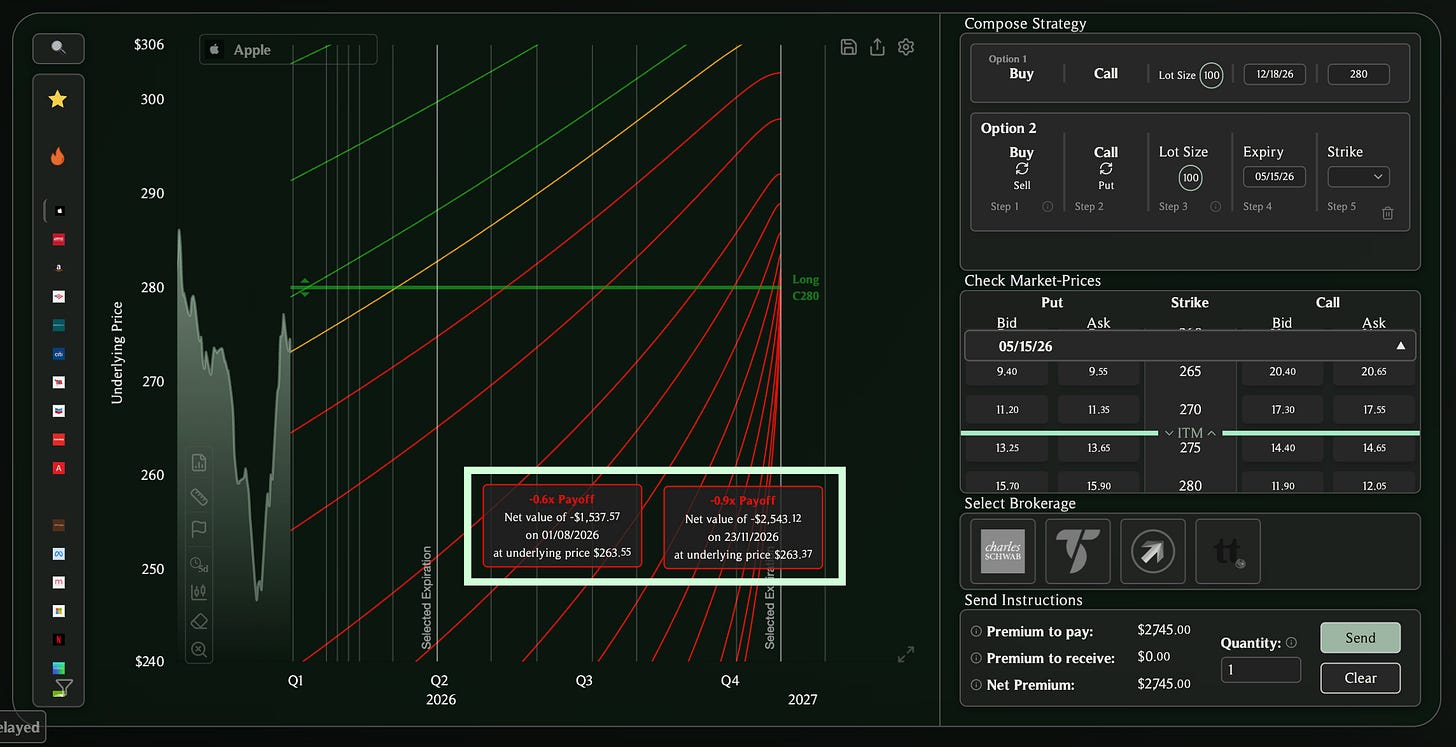
Then there's the dreaded IV crush; the one that got me every time. You enter a trade, the underlying moves exactly as expected, and yet the option loses value as IV collapses. The market has simply repriced optionality, wiping out your gains.
Sometimes this is unavoidable. Other times, the warning signs are obvious: earnings, major announcements, or known events that drive IV higher beforehand and cause it to collapse immediately after. And in many cases, as discussed in the entry strategy section, the issue is simpler (you overpaid for optionality in the first place).
So keep your eyes on the prize and make sure you're looking out for the value killers.
Exit
The discipline to exit
Whether you're sitting on a winner or watching a position bleed, finding the discipline to exit can be incredibly difficult and is often more of a mind game than anything else. The thought is always the same: If I exit now, what if it suddenly jumps? And this isn't unique to losing trades; it affects winners just as much.
The solution is often to remove discretion and emotion altogether. Set clear exit thresholds that align with your strategy, such as closing at a 20% loss or a 20% gain, and actually stick to them.
Because since when did locking in a 15% profit become a failure simply because the trade could have reached 25% later? If your objective is long-term consistency, pre-defined risk limits are quite literally integral.
But of course, you need to stick to them. Which brings us nicely to….
Limit placement
Every brokerage provides the infrastructure for limit orders, and they can be a lifesaver, especially when it comes to enforcing risk limits.
You can predefine exits so that a sell order is automatically placed at a 20% gain, or a stop-limit order triggers at a 20% loss to cap further downside. This removes your emotional involvement at the most critical moments, while still being entirely driven by your own predefined rules.
This approach is especially valuable when trading options in non-local markets, where you may not have real-time visibility into price movements.
I actually enjoyed reliving my old faux pas in this article because it reminds me how far my options trading journey has come in relatively little time. Options are such a unique asset class, and they require the community to constantly generate useful content that can improve trading outcomes for us retail traders who often don't trade as a profession. I hope this article helped!